Exploring Ethics in Management
In 2015, Volkswagen lost over $30 billion after it was caught cheating emissions tests. The company did not fail because people lacked skills or knowledge. It failed because ethics in management broke down.
And this is more common than we think.
A recent report by the Edelman Trust Barometer found that over 80% of people say they must trust a company before they buy from it. That means ethics in management is no longer just a “nice to have.” It directly affects profit, reputation, and long-term success.
But here is the real problem.
Most managers are not trained in ethics in management. They are trained to hit targets, meet deadlines, and deliver results. So when tough situations come up, they rely on instinct. And that is where mistakes happen.
Ethics in management is not about big speeches or company values on a wall. It shows up in small, daily choices.
- Do you speak up when something feels wrong?
- Do you stay honest when it might cost the company money?
- Do you treat people fairly, even under pressure?
These moments may seem small. But over time, they shape the culture of a company.
In this article, we will break down what ethics in management really means in practice. We will look at real company examples, simple frameworks you can use, and what great leaders actually do differently.
Because in the end, ethics in management is not about knowing what is right. It is about doing it, especially when it is hard.
What this looks like in real life
Ethics in management sounds like a big idea. But when you break it down, it is actually very simple.
Ethics in management is about the choices managers make every day. Not just the big decisions, but the small ones too. It is the way leaders decide what is right and what is wrong when there is pressure, risk, or uncertainty.
In simple terms, ethics in management is a set of values that guide actions. It helps managers decide how to treat employees, customers, and partners. And it shapes how a company behaves when no one is watching.
But here is where it gets real.
Ethics in management is not tested when things are easy. It shows up in moments like these:
- A manager choosing between hiring the best candidate or someone they know
- A company deciding whether to be fully honest with customers about a mistake
- A team leader deciding whether to speak up about unfair treatment or stay quiet
These are everyday situations. And this is where ethics in management actually lives.
Let’s take a simple example.
Imagine a company realizes that one of its products has a small defect. Most customers may never notice it. Fixing it will cost a lot of money.
An unethical decision would be to ignore the problem and keep selling.
An ethical decision would be to take responsibility, fix the issue, and be honest with customers.
This is exactly what Johnson & Johnson did during the Tylenol crisis. They recalled products across the country, even though it cost them millions. In the short term, they lost money. But in the long term, they gained trust.
That is the real power of ethics in management.
It is not about being perfect. It is about making the right call, even when it is difficult.
Let’s Take An Example of Ethics in management here:
It is easy to talk about ethics in management. It is harder to see what it looks like in real life.
One of the clearest examples comes from Bill Gore, the founder of W. L. Gore & Associates.
Instead of creating strict rules and policies, he focused on something different. He built a culture based on simple ethical principles. And more importantly, he made sure people actually understood them.
He spent time meeting small groups of employees. Not in formal meetings, but in real conversations. He explained how the company should work and what kind of behavior was expected.
The company followed four key principles:
- Be fair with everyone you work with
- Help others grow and take responsibility
- Keep your commitments
- Involve others when making decisions
At first, this sounds simple. But what makes this powerful is how it was applied.
A More Modern Example
You can see a similar approach in Patagonia.
The company made a bold decision to donate its profits to environmental causes. But more importantly, it aligns its daily decisions with its values.
For example:
- It encourages customers to repair clothes instead of buying new ones
- It is transparent about its supply chain
- It speaks openly about environmental impact
From a short-term view, some of these decisions reduce profit. But in the long term, they build deep trust and loyalty.
A study on the ethics in management conducted by Barry Posner and Warren Schmidt highlights the following:
- A manager’s primary goal is to make their organisation effective. Boosting profits and the interests of stakeholders were not their core priorities.
- Attending to clients was seen as necessary.
- The quality most highly valued by managers at all levels was integrity.
- The pressure to stick to organisational expectations is seen to be high.
- In helping their mates cope with ethical dilemmas, spouses are essential.
In ethical confusion, most managers seek the counsel of others.
What You Can Actually Do as a Manager for ethics in management
If you want to apply ethics in management like Gore or Patagonia, it starts with small actions.
Here is what that looks like in practice:
1. Make expectations clear (and simple)
Do not overload people with long policies. Define 3–5 clear principles and repeat them often.
2. Model the behavior yourself
People do not follow rules. They follow what leaders do. If you cut corners, your team will too.
3. Reward ethical behavior, not just results
If someone hits targets but behaves poorly and still gets rewarded, your culture is set.
4. Create space for input
Before making decisions, ask: “Who else should be involved?” This builds fairness and trust.
5. Follow through on commitments
Trust is built when words match actions. Even small broken promises damage credibility.
10 Ethical Behaviours
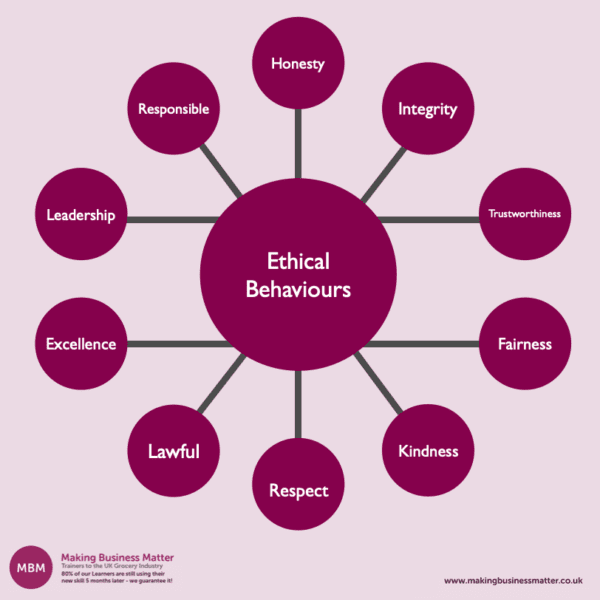
Here are 10 behaviours that outline ethics in management:
1. Honesty ethics in management
In ethics in management Honesty means telling the truth early, even when it is uncomfortable.
When Johnson & Johnson discovered that its product had been tampered with and linked to deaths, it did not wait. The company recalled millions of bottles nationwide and warned the public immediately.
They lost money in the short term, but they became a long-term example of trust.
What to do:
- Share bad news early
- Avoid half-truths
- Own mistakes clearly
2. Integrity
Integrity is about being consistent and isss key on ethics in management. What you say, do, and reward should match.
At Uber, rapid growth came with internal culture problems. Reports of harassment and poor leadership behavior showed a gap between company values and reality, which led to leadership changes.
What to do:
- Align actions with words
- Do not reward bad behavior, even if the results are good
- Stay consistent under pressure
3. Trustworthiness in ethics in management
Trust is built when people know you will follow through.
At W. L. Gore & Associates, employees are expected to keep commitments. The company runs on trust rather than a strict hierarchy, so reliability directly affects credibility.
What to do:
- Only promise what you can deliver
- Track commitments
- Communicate early if plans change
4. Fairness
Fairness is about making decisions people can trust.
Salesforce conducted internal reviews and found pay gaps. Instead of ignoring them, the company spent millions to correct salaries and continues to audit regularly.
What to do:
- Review pay, promotions, and workload
- Be transparent in decisions
- Check your bias
5. Kindness ethics in management
Kindness means considering the impact of your decisions on people.
During COVID-19, Airbnb had to lay off employees. But instead of handling it quietly, they offered support packages, extended benefits, and even helped employees find new jobs.
What to do:
- Be direct but respectful
- Support people in tough moments
- Think beyond just business outcomes
6. Respect
Respect is how you treat people, especially when you have power.
Google faced internal backlash when employees felt their concerns were not taken seriously. This highlighted how quickly trust drops when people feel unheard.
What to do:
- Listen fully
- Do not dismiss ideas quickly
- Treat everyone with equal dignity
7. Lawful
Following rules is the baseline of ethics in management.
The Volkswagen installed software to cheat emissions tests. This decision boosted short-term performance but led to massive fines and long-term damage.
What to do:
- Understand the rules
- Avoid “loopholes” that go against intent
- Ask when unsure
8. Excellence
Excellence means doing things the right way, not just fast.
At Toyota, workers can stop the production line using an Andon cord if they notice a problem. This protects quality and prevents bigger failures later.
What to do:
- Set standards for behavior and results
- Encourage speaking up
- Invest in improvement
9. Leadership
Ethical leadership means setting the example.
Satya Nadella shifted Microsoft from a competitive internal culture to one focused on learning and empathy. This improved collaboration and performance.
What to do:
- Model the behavior you expect
- Admit mistakes
- Encourage open discussion
10. Responsible ethics in management
Responsibility means owning outcomes, especially when things go wrong.
At Wells Fargo, employees opened fake accounts to meet targets. Leadership failed to take responsibility early, which made the situation worse.
What to do:
- Take ownership early
- Fix issues, do not deflect
- Address problems directly
Approaches To Ethics In Management
Basically, there are 3 approaches to ethics in management. Each of them is discussed in the points below:
1. Consequence-Based Approach
Managers check their decisions ethics in management through this approach. Here, the emphasis is on the action and not the reason behind the action. It measures positive and negative outcomes. If the positive effects outweigh the negatives, company decisions are justified.
In this approach, managers analyse the potential options before taking a specific action.
For example, a manager might receive more revenue from fees or company donations from bringing on a certain event in a city. It can be an adventure programme such as boxing, but it will have a harmful effect on a number of residents.
They might fear noise pollution or harm from competitors or loss of property during the programme.
Here, the manager would look at this event from a cost-benefit viewpoint. He will conclude that most people in the group would appreciate this activity. And that the company would make more money from providing the programme. The manager will also ignore the neighbours concerned about potential damage and noise.
It will bring more money to the organisation. But the disappointed residents could sue for property damage. Moreover, it might lead to an expensive case for the organisation.
2. Moral Rights Approach ethics in management
In this strategy, managers adopt a moral code that takes care of natural and moral rights. It includes the right to speech, life, and protection, as to express emotions, etc.
Managers reveal all the necessary details in the annual reports. When disclosing information, its time and validity are taken into account.

For example, a manager may see that it is difficult for some of the workers to engage in official training. It might be because they lack the necessary skills. Or, they might have a different challenge in participation. Some might even have a financial crisis.
Managers with the moral rights approach should determine specific responsibilities. They should help group members who are facing issues. They should check whether specific duties are required.
One clear advantage of this approach is supporting the disadvantaged person. The manager can make some reasonable settings for the same. The downside is that it may put the disadvantaged in the limelight. It will make them feel unjust.
3. Social Justice Approach
Managers who take the social justice approach look for equality and fairness. No one is discriminated against based on caste, religion, race, or gender. But differences are justified based on skills or performance.
For example, workers belonging to any gender, with the same abilities are equal. But treating employees who produce better than those who make less is justified.
This approach has two principal theories – the liberty principle and the difference principle.
The Liberty Principle
Every person has some fundamental freedom. Those should be consistent with other people’s equal freedoms.
The Difference Principle
It stands for resolving social and economic bias. It supports the equal distribution of goods and services.
Types of Workplace Ethics
Archie B. Carroll has identified three types of management ethics or standards of conduct. They are as follows:
1. Immoral Management
It suggests a lack of ethical standards that managers adopt. Even if it is harmful to ethical requirements or employee concerns, managers want to maximise profits.
2. Moral Management
In this, managers strive to increase profits, considering ethics. They adhere to standards of conduct that are ethical and legal. The core principle here is, ‘Is this action fair to us and all parties involved?’
3. Amoral Management ethics in management
It falls between moral and unethical management ethics. Managers only react to personal and legal ethics if they are expected to do so. Otherwise, there is a lack of ethical interpretation.
Two types of amoral management are applicable:
Intentional
According to Bob Dunn, President and CEO of Business for Social Responsibility:
Ethical decisions aren’t as easy as they used to be. Now, they’re the difference between right and right.’
It is relatively easy to choose between right and wrong by depending on principles. But business often demands that we select from alternatives that are neither wholly right nor wholly wrong.
In organisations today, most managers ignore ethics on purpose. They believe that corporate ethics is meaningless. It is because instruction in business ethics ignores real-life challenges. According to them, ethics should be practised only for non-profit motives.
Unintentional
Here, managers do not avoid ethics on purpose. But, they casually make choices when moral consequences are not taken into account.
Leave a Reply